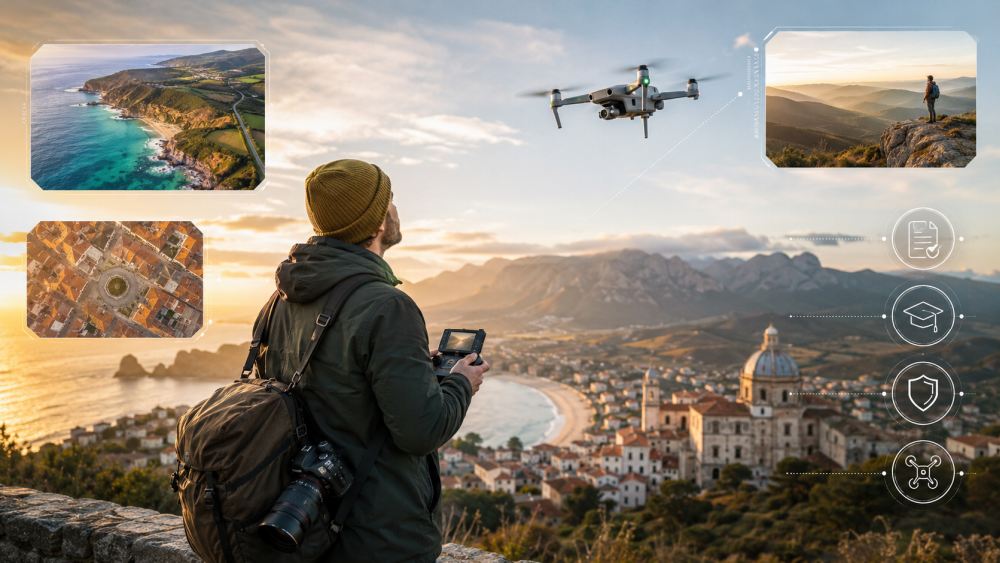

Drone photography isn’t traditional photography’s replacement — it’s a different tool for a different job. A ground camera gives you control: precise lighting, sharp detail, eye-level connection with people. A drone gives you scale and perspective a ladder never will. Knowing which one a job actually needs, and when you want both, is the real question behind “drone vs traditional photography.”
Quick answer: Use drone photography when you need scale, aerial shots, or footage of something too large or awkward to shoot from the ground — building exteriors, construction sites, team shots outside your premises, large industrial spaces. Stick with traditional photography for anything close-up, controlled, or people-focused, like headshots or product work. Most of my commercial jobs use both cameras, and as a CAA-licensed drone operator, I typically build drone time straight into a booked session rather than charging it as a separate shoot.

What’s the Real Difference Between Drone and Traditional Photography?
Traditional photography is shot from the ground, at human eye level or close to it. That’s exactly why it works so well for headshots, portraits, and anything where connection with the subject matters — you’re photographing people the way people actually see each other.
Drone photography starts from above, and that changes what you can capture entirely. Instead of one building facade, you get the whole site from an aerial perspective. Instead of a team crowded into a doorway, you get them spread out with the company logo overhead. It’s not better or worse than traditional photography — it’s a genuinely unique perspective, and some stories can only be told from it.
Before drones, that aerial perspective meant hiring a helicopter — expensive, slow to arrange, and overkill for most commercial jobs. A drone gets you the same aerial photography for a fraction of the cost and hassle, which is exactly why it’s become such a cost-effective addition to a normal shoot rather than a rare, special-occasion extra.
When Does Drone Photography Win Over Traditional?
Here’s how I actually decide which tool fits a job, based on what clients ask for most:
| Situation | Better choice | Why |
|---|---|---|
| Headshots, portraits, personal branding | Traditional | Needs eye-level connection and controlled lighting a drone can’t give you |
| Team photo outside the building | Drone | Fits a whole team in shot without cramming everyone together, and the overhead angle is genuinely flattering |
| Product or interior detail shots | Traditional | Needs close control over lighting and focus that a drone at altitude can’t match |
| Construction or industrial site progress | Drone (plus ground shots) | Shows scale and layout that no ground camera can capture in one frame |
| Large facility or new machinery install | Drone | Captures the full scale of a space or install that ground cameras simply can’t fit in |
| Operational b-roll (yards, loading bays, quarries) | Drone | Gives dynamic, moving footage of activity across a wide area in a way handheld video can’t |
Is Drone Photography More Expensive Than Traditional Photography?
Not necessarily, and this is where a lot of people overthink it. I price everything by time, not by equipment — the packages are the same 2-hour, half-day, and full-day sessions I use for any commercial job (I’ve written more about how I price my photography by time, including how drone add-ons fit into that).
Drone work usually gets built straight into a booked session rather than charged as a standalone extra, unless the job is drone-only. What can add cost is complexity around permissions — a site close to an airport, airfield, or prison may need extra planning or sign-off before I can fly at all, and that’s factored in upfront, not sprung on you afterwards.
Real Ways I Use Drone Photography for Business Clients
These are the actual use cases that come up again and again on commercial jobs:
- Team photos outside the building. Even a small team looks different from above — it’s a genuine alternative to the usual lined-up group shot, and it solves the “shy person hiding at the back” problem, since everyone naturally looks up into the lens. Positioned under the company logo on a sunny day, it’s one of the simplest wins a drone offers.
- Property and site photography. I’ll often start close on the building and pull back gradually, ending on an aerial view that shows the whole site — useful for pointing out specific areas like manufacturing zones, offices, canteens, or fire routes.
- Large facilities and new machinery. For manufacturers with big internal or external spaces, a drone captures the full scale of the site in a way a ground camera physically can’t. New machinery installs are a good example — the whole thing in one frame, not a series of close-ups stitched together.
- Video circuits and reveals. A drone can do a full circuit around a building for dynamic footage, or start tight on your company logo and pull backwards — reverse that clip in the edit and you get a striking zoom-in effect without any additional kit.
- Operational b-roll. Car parks, loading bays, quarry operations, conveyor belts — anywhere there’s activity across a wide area, a drone captures it moving and alive rather than as a static wide shot.
- FPV walkthroughs. First Person View drones are less common but genuinely immersive — I fly wearing goggles that show exactly what the drone sees, which allows tighter, more intricate moves: through an open car window, close past factory equipment, or a real-time tour of a facility with staff going about their day. One tip from experience: tidy up loose paper before an FPV flight indoors — the prop wash will find it.
What Are the UK Rules Around Drone Photography?
This is worth knowing even if you’re not the one flying, because it affects timelines and what’s possible on your site. In the UK, commercial drone work needs proper registration: a Flyer ID for anyone flying a drone over 250g (or a lighter one with a camera), and an Operator ID for whoever’s responsible for it. Flights are capped at 120m altitude, and the drone has to stay within visual line of sight at all times — no flying it out of view over a large site.
Airports, airfields, and other restricted airspace (that includes prisons) are no-fly zones without specific permission, which is exactly why a site near one of these can take extra planning. Commercial work also needs third-party liability insurance as standard — not optional, whoever’s flying. Drone technology has become far more accessible over the last few years, but the licensing and airspace rules are exactly as strict as they were when it was a niche, expensive tool. If you’re curious about the practical side of getting started with a drone yourself, I’ve written a fuller guide on what photographers need to know about their first drone.
Drone Photography for Construction and Industrial Sites
Construction and industrial work is where drone and traditional photography genuinely need each other. Ground shots capture the human element — people, detail, close-up progress. Drone shots capture the story ground cameras can’t: the whole footprint of a site, how phases relate to each other, and how a project is actually progressing week to week. I’ve covered this in more depth in construction photography and specifically in how drone photography transforms construction site oversight, if you want the fuller picture.
FAQ
What are the advantages of drone photography over traditional photography?
Scale and perspective, mainly. A drone shows an entire site, building, or team in one frame from an angle a ground camera can’t reach — genuinely useful for construction, property, and large facilities, but not a replacement for close, controlled, people-focused work.
Is a drone better than a camera?
Neither is “better” — they do different jobs. A drone is a camera on a different vantage point. For headshots, product shots, or anything needing tight control over lighting and framing, a ground camera wins every time.
Is drone photography more expensive than traditional photography?
Not inherently. I price by time rather than equipment, so drone work usually slots into the same 2-hour, half-day, or full-day packages as any other job. Cost mainly rises when a site needs extra permissions, like proximity to an airport or restricted airspace.
Do you need a licence to fly a commercial drone in the UK?
Yes. A Flyer ID and Operator ID are required for most drones with a camera, flights are capped at 120m altitude with the drone kept in sight at all times, and commercial work needs third-party liability insurance as standard.
Can drone and traditional photography be booked together?
Yes, and most of my commercial jobs use both — ground shots for people and detail, drone for scale and context. It’s usually more efficient to book them as one session than as two separate shoots.
Cheers,
Ade