
Why AI Still Can’t Fake Real Photography
AI-generated photography is imagery produced by a model that has learned visual patterns from millions of real photos scraped off the internet, rather than a photograph taken by a camera, in a real place, at a real moment.
Quick answer: can AI actually create a genuinely great photograph?
Not reliably, and not yet. AI learns from whatever’s most common online, which is mostly average phone snaps rather than great photography. It can produce something technically polished, but it doesn’t know what “good” looks like – only what’s common. That’s why AI images often look subtly off: skin too smooth, lighting that doesn’t behave like real light, people who are a bit too perfect. For anything that needs to look genuinely real, you still need someone behind a camera who understands light.
How does an AI actually learn what a photo should look like?
An AI image model is trained by trawling enormous amounts of internet content and building it into something called a large language model, or an image equivalent of one. It doesn’t “understand” photography – it’s spotting statistical patterns across millions of examples and learning to reproduce them.
For subjects like law, maths, or English prose, this works well. There’s a huge volume of excellent, easy-to-find material – great novels, solid journalism, clear legal writing – so the model has plenty of genuinely good examples to learn from.
Photography doesn’t have that luxury. Genuinely great photography online is a tiny fraction of what’s actually out there, and the model has no reliable way to sort the good from the average.
Why do AI images look “off” even when they’re technically stunning?
Think about what actually gets uploaded to Facebook, Instagram, and the rest – the platforms AI models draw heavily on. It’s mostly ordinary phone photos, a lot of them from beginners who are prolific precisely because they’re just starting out and keen. Roughly 94% of all photos taken are now expected to come from smartphones rather than proper cameras, so that’s the bulk of what the model is learning from.
That shows up in the output. AI-generated portraits often sit in the “uncanny valley” – close enough to real to unsettle people, not close enough to convince them. The usual tells: no catch light in the eyes, shadows that don’t commit to a single light direction, and skin that’s missing the pores and uneven tone real skin has. It’s why so many AI images end up looking more like an illustration or a manga character than a photograph – the lighting was worked out by maths, not by someone putting up a light and a modifier.
Why can’t AI just learn from the best photography instead of the average stuff?
Because it has no objective way to judge quality. An AI model can’t look at one photo and say “this is good,” then look at another and say “this isn’t.” It can only go on metadata and what people have written about an image – captions, alt text, engagement – not the actual visual judgement a trained eye makes.
There’s also a training data bias problem on top of that. If the data an AI has seen leans heavily toward certain lighting setups, skin tones, or architectural styles, the model will lean the same way in what it produces, and it’ll struggle with anything under-represented in what it was fed.
What does this mean for the value of real, human-taken photography?
If anything, it makes it more valuable, not less. In one study, a recognisable photo of an actual company founder produced a 35% higher conversion rate than a generic stock-style image – people respond to what’s authentic, and they’re getting better at spotting what isn’t.
The photography industry isn’t really debating AI versus real photography as an either/or. Most working photographers are using AI to handle volume and routine editing, and keeping real shoots for the work that actually depends on a genuine subject, place, or moment – brand photography, events, finished buildings, a client’s actual product.
| Task | AI handles this well | Still needs a photographer |
|---|---|---|
| Removing litter or a stray person from a shot | Yes | – |
| Cleaning up a distracting background | Yes | – |
| A photo of your actual product, site, or building | – | Yes |
| Capturing a real client event or moment | – | Yes |
| Generic “lifestyle” background imagery | Yes | – |
| A photo a client will recognise as genuinely theirs | – | Yes |
Do you need to disclose AI-generated images legally?
It’s heading that way. The EU AI Act’s Article 50 requires providers and deployers to mark or disclose AI-generated and manipulated content from 2 August 2026. The industry standard for this is called Content Credentials (C2PA) – a signed manifest embedded in the file recording how an image was made, backed by Adobe, Microsoft, Google, Meta, and OpenAI.
Worth knowing: platforms like Instagram, X, and WhatsApp strip that metadata out when you upload, because of how they recompress images. So the label doesn’t always survive the journey – something to bear in mind if you’re relying on disclosure happening automatically.
Camera brands, AI, and the same underlying con
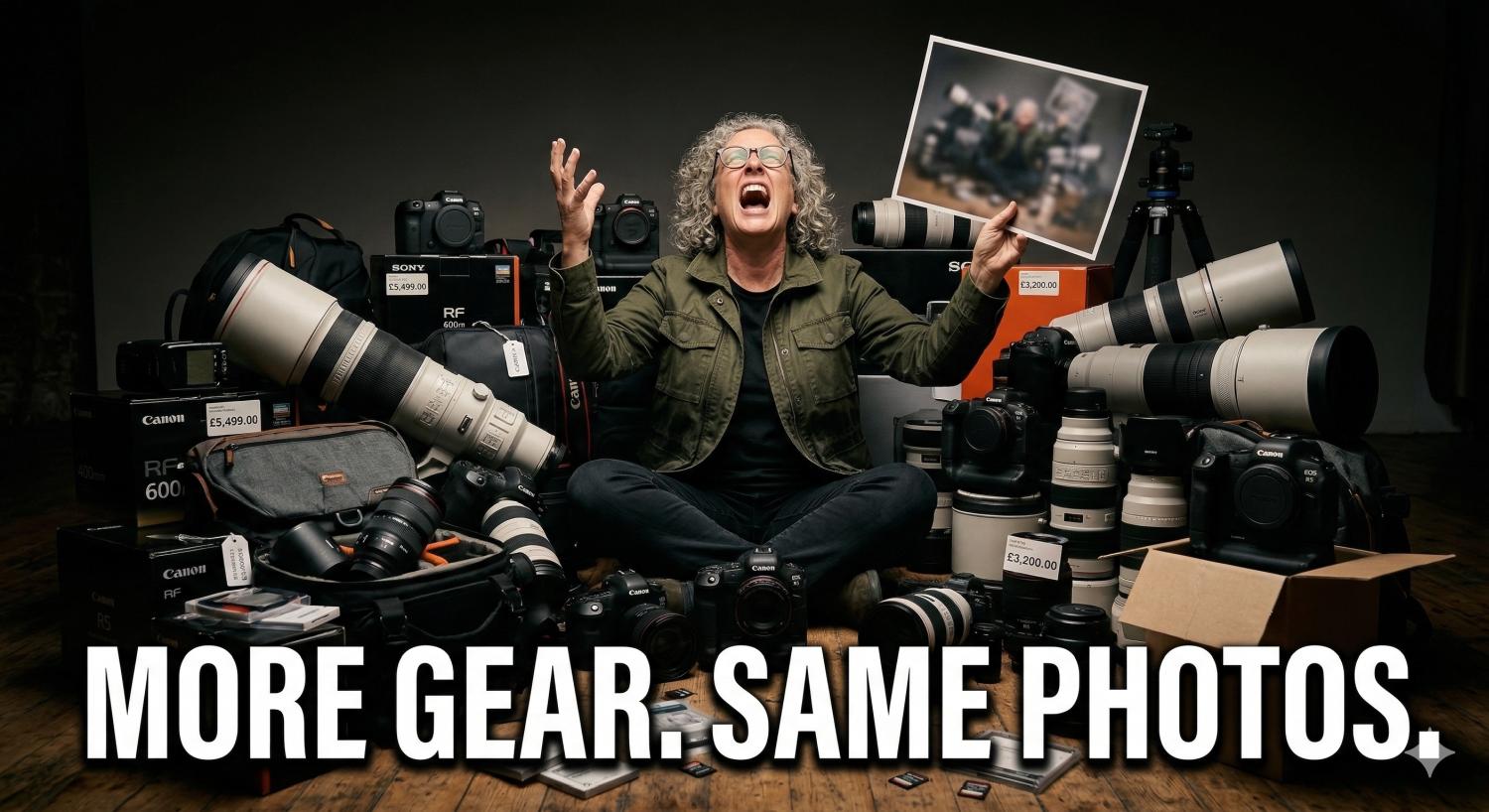
This isn’t the first time “the tech will sort it” has been oversold to photographers. I’ve written before about the one thing camera brands hope you never realise – that a better camera doesn’t make you a better photographer. AI image generation is the same pitch in a new wrapper: the tool can’t substitute for someone who understands light, composition, and what a subject actually needs.
If you’re already using AI tools elsewhere in your business – for marketing copy, customer queries, that sort of thing – the same principle applies as it does with images: the output is only as good as what you feed it. I’ve covered that side of things separately in Context Is King: how to give AI real context about your business.
Where AI genuinely earns its place, for photographers and the people who hire them, is as an editing tool rather than a creation tool: removing litter from a road, taking a stray passer-by out of a property shot, cleaning up a background – all quick jobs, all reliable, because there’s a real photograph underneath doing the actual work. Generating a convincing image from scratch is a different problem entirely, and for now, it’s one AI hasn’t solved.
FAQ
Is an AI-generated image a “real” photograph?
No. A photograph records light that actually existed in front of a lens at a specific moment. An AI image is a statistical guess built from patterns in millions of other pictures, with no lens, no moment, and nothing that was ever really there.
How can you tell if an image is AI-generated?
Check the eyes for a catch light that doesn’t match the light source, check whether shadows commit to one direction, and look at skin up close. Real skin has pores and uneven texture; AI skin is often suspiciously smooth.
Will AI replace photographers?
Not for anything that depends on a specific real subject, place, or moment – a product on your shelf, a finished building, a client’s actual event. AI is already replacing some generic stock and background imagery, but not photography of things that actually exist.
Do I have to label AI-generated images used in my marketing?
Under the EU AI Act’s Article 50, providers and deployers must disclose AI-generated or manipulated content from 2 August 2026. The UK hasn’t mandated this yet, but if you trade with EU customers or want to stay ahead of where the rules are heading, it’s worth building the habit now.
Can I use AI to edit real photos instead of generating new ones?
Yes, and this is where AI is genuinely useful for photographers already. Removing litter from a street scene, taking out a stray person from a property shot, cleaning up a distracting background – all quick, all reliable, because the photo underneath is real.
Cheers,
Ade