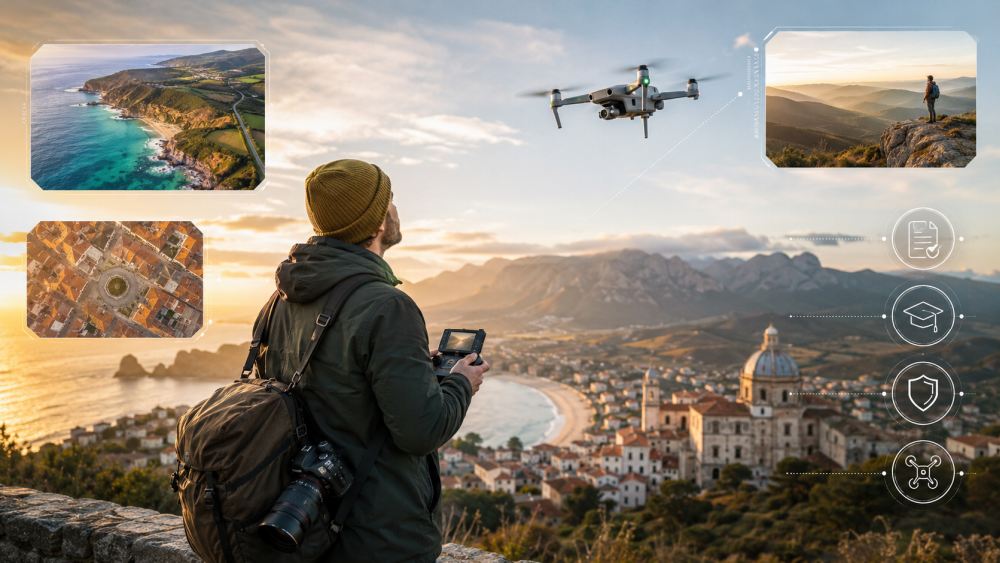
Drone photography is the use of an unmanned aircraft to capture aerial stills and video, and for many existing photographers it’s one of the easiest new skills to add in 2026 — provided your genre actually benefits from the height.
Quick answer: should you get into drone photography?
If you shoot landscapes, architecture, seascapes or portraits, yes — drones add a genuinely new angle. If you’re mainly wildlife, still life or studio/flash work, there’s very little use case, so don’t feel you’re missing out by skipping it. Try before you buy if you can, start with a DJI Mini 5 Pro, get your Flyer ID and Operator ID sorted, and practise in an open field before you do anything ambitious.
Is a drone actually worth it for your type of photography?
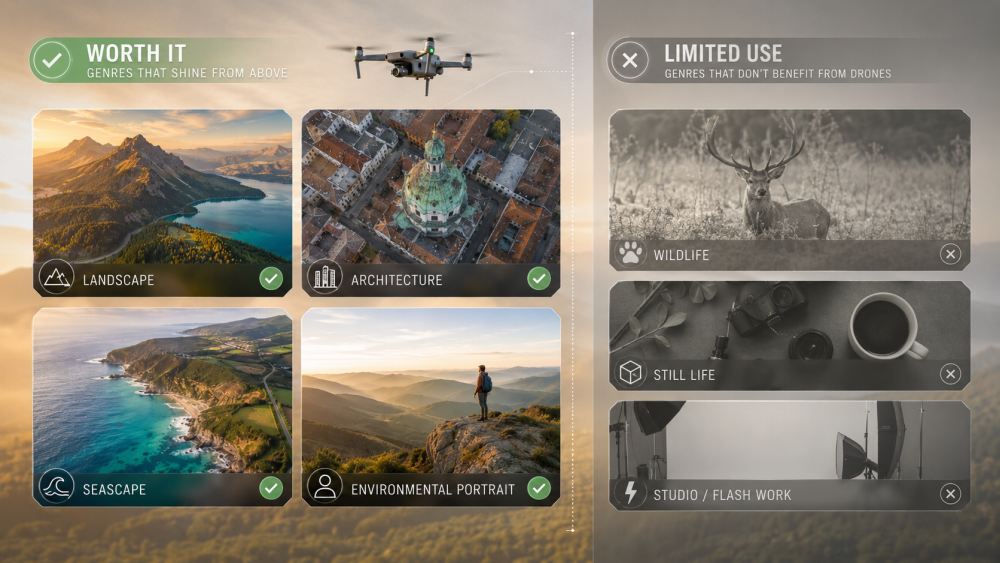
This is the first question, and it’s not a yes-for-everyone answer. Drones genuinely add something for these niches:
| Good fit for drones | Little or no use |
|---|---|
| Landscape | Wildlife |
| Architecture | Still life |
| Seascape | Studio and flash work |
| Portrait (environmental) |
If you’re already doing drone work for construction or industrial clients, the same logic applies — height adds context that ground-level shots can’t.
Should you try a drone before buying one?
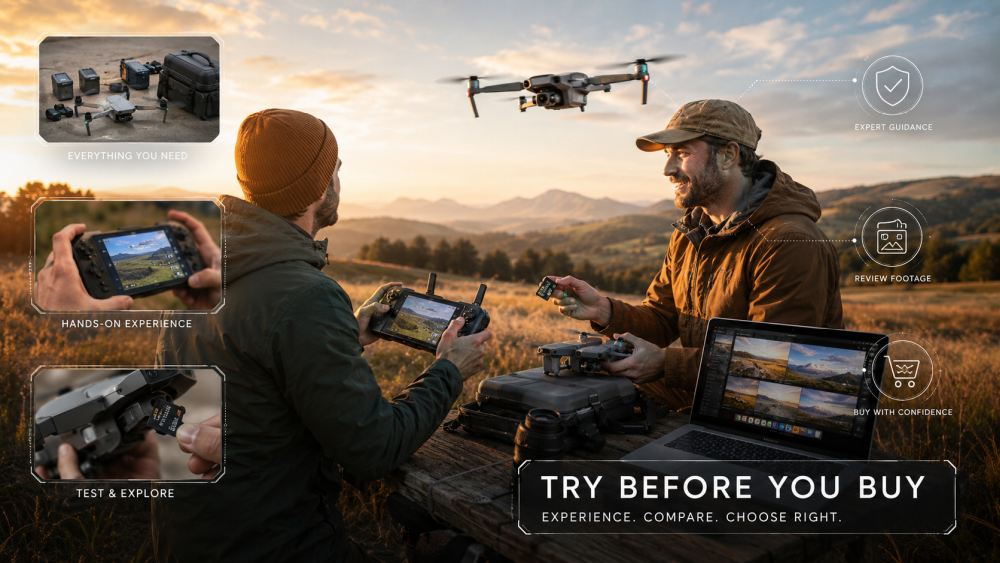
Yes, if you possibly can. Either ask a friend who flies to send over some raw files so you can judge image quality, or better still, go out with them and fly with your own memory card in. That gives you real footage to review, and either reassures you or saves you the spend.
Which DJI drone should a photographer buy first?
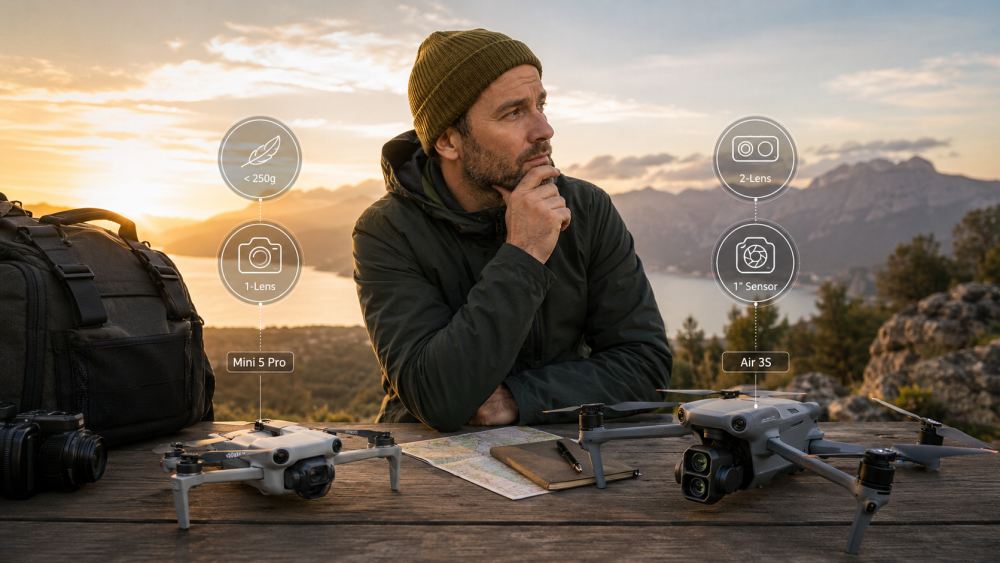
DJI is the industry standard for good reason: regular firmware updates, mature software, and everyone else uses them too, so advice and accessories are easy to find. Two sensible starting points:
- DJI Mini 5 Pro — sub-250g, so it stays in the lightest-regulated category. Fly More Combo runs roughly £869–£979 depending on controller, with a 1-inch sensor and a single 24mm-equivalent lens.
- DJI Air 3S — more budget, more capability. Fly More Combo runs roughly £1,099–£1,439 depending on bundle. Adds a second 70mm lens for extra reach, at the cost of being well over the 250g weight line.
If budget’s tight, look at DJI’s smaller Mini range, or used demo stock and second-hand Mini 3 Pro or Mini 4 Pro units — plenty of people upgrade purely because a new model exists, not because the old one stopped being good.
Whichever you choose, buy the Fly More package, not just the drone. You get spare propellers, a carry bag, and crucially three batteries plus a multi-battery charging hub — meaning you can trickle-charge through the day and get a full day’s creativity out of one trip, instead of one short flight every hour or two with a single battery.
What’s the first thing to do when the drone arrives?
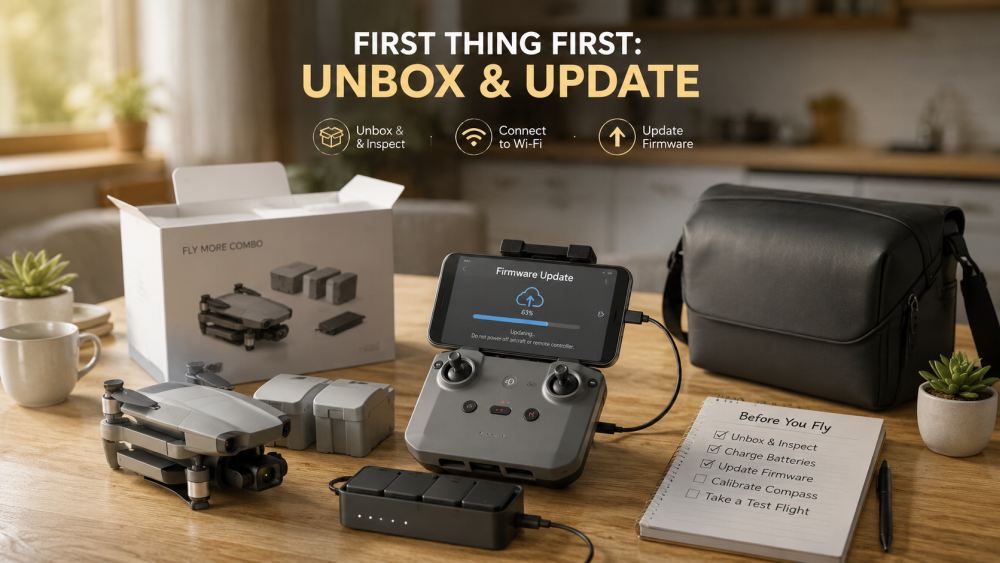
Switch the handset and drone on, connect to your home Wi-Fi via the DJI Fly app, and check for firmware updates on both the drone and controller before you fly. New stock is rarely shipped with the latest firmware, and updates often bring stability improvements or new features you wouldn’t otherwise get.
Is DJI Care Refresh worth it, and does it cover everything?
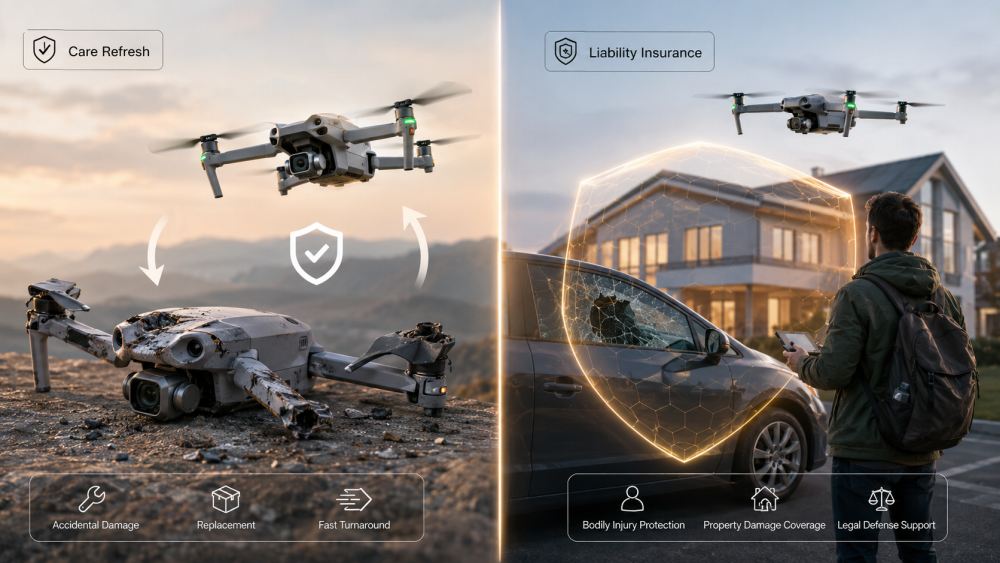
Care Refresh is worth having. If you crash or smash your drone, a replacement typically costs around £40–£60 rather than the £250 excess a normal insurer might charge — and it doesn’t bump your premium afterwards the way an insurance claim would.
What it doesn’t do is cover anyone else. Care Refresh only protects your own aircraft. If you damage someone’s property or injure a person, that’s a third-party liability claim, and recreational flyers have no legal obligation to carry it — though it’s strongly recommended, and bundled into memberships like BMFA or FPV UK. Commercial drone work is a different matter: liability insurance compliant with the relevant regulation is a legal requirement, not optional.
What qualifications do you actually need to fly legally in the UK?
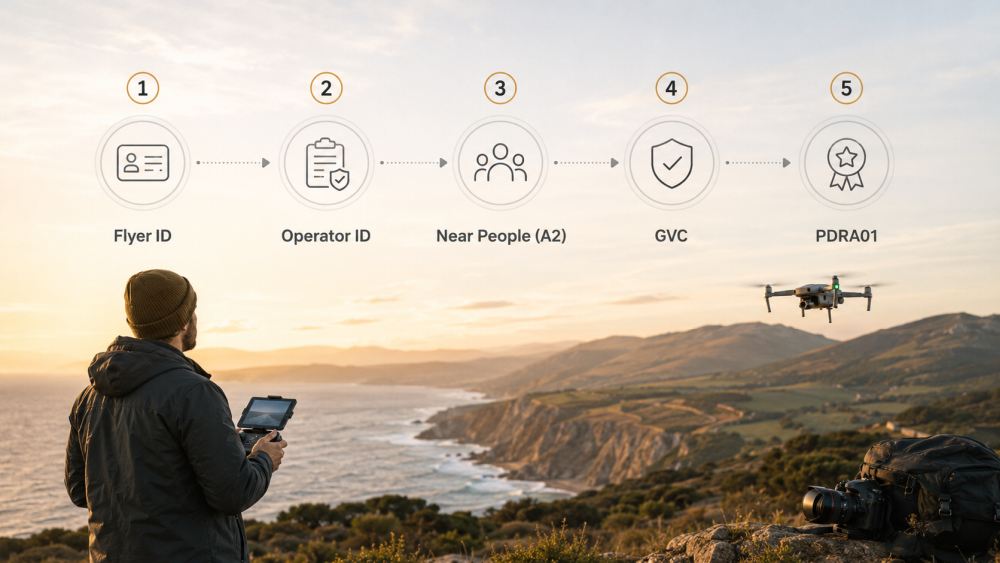
UK drone law changed significantly on 1 January 2026, so a few widely-repeated numbers are now out of date. Here’s where things actually stand:
- Flyer ID — free, a short online test. Now required for any drone weighing 100g or more, not 250g as it used to be.
- Operator ID — required if your drone has a camera. Now £12.34 a year, displayed on the aircraft.
- A2 CofC — still exists, renamed the Near People (A2) qualification. Theory-only, roughly £100–£250, valid five years, no annual renewal fee.
- GVC — the commercial-grade qualification: longer course, includes a practical flight test, unlocks Specific Category operations.
- PDRA01 — the Operational Authorisation for planning and executing commercial jobs. CAA fee is £500–£524, renewed annually.
If you’re only flying for fun in open countryside, the Flyer ID and Operator ID may be all you ever need. If you want to work in towns or take on client jobs, the A2 CofC or GVC is where the real flexibility comes from.
How has UK drone law changed for built-up areas in 2026?
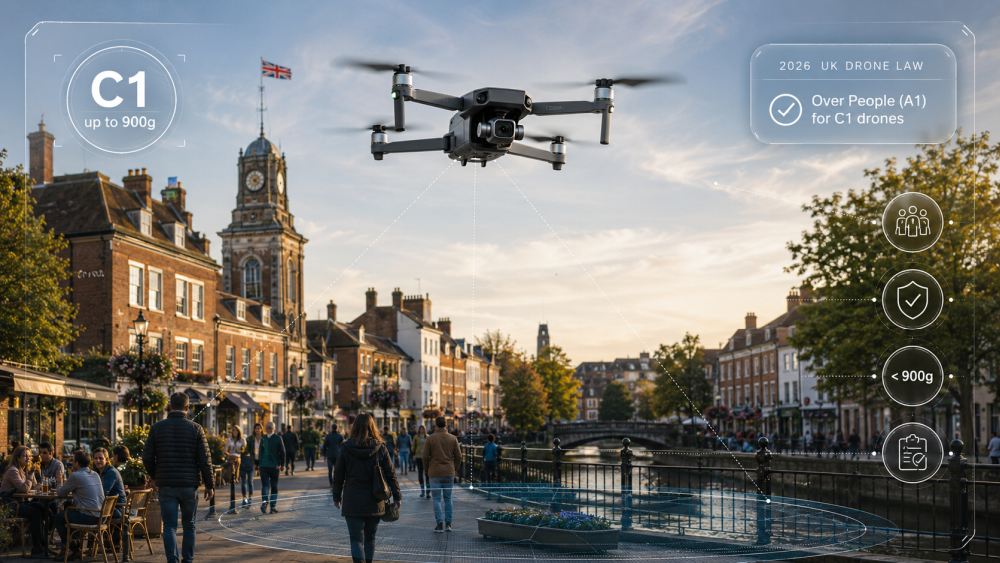
This is the bit worth getting precise about. From 1 January 2026 until 31 December 2027, C1-class drones — and the CAA’s own guidance specifically names the DJI Air 3S as an example — can fly in the “Over People” (A1) sub-category up to 900g. That’s a privilege which used to be reserved for sub-250g drones only, so a heavier drone with a second lens is now usable in far more places than it would have been a couple of years ago.
The Mini 5 Pro, sitting at 249.9g, stays in the lightest UK0/C0 category regardless, so this change matters most if you’re deciding between the two models for work in towns and cities.
How do you learn to fly safely before doing anything ambitious?
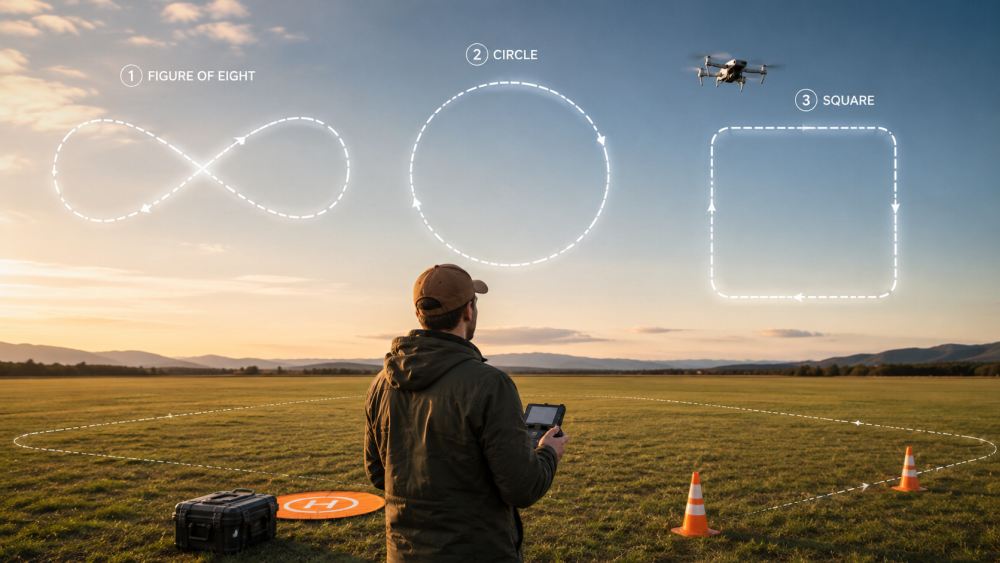
Find a big, open space — a field clear of trees, pylons and cables — and just get used to the controls before attempting anything creative. Keep the flight mode in Cinematic or Normal rather than Sport, since Sport switches off safety features and the drone moves fast enough to write itself off against a wall.
Useful practice patterns:
- A figure of eight in the sky
- A perfect circle
- A square flown around yourself, with the camera always pointing inward — this forces you to fly sideways, which takes some getting used to
Smooth manoeuvring matters more than speed. Ease into corners rather than jerking the sticks — jerky turns in finished video genuinely make people feel a bit sick when they watch it back.
How do drone camera settings differ from a DSLR?
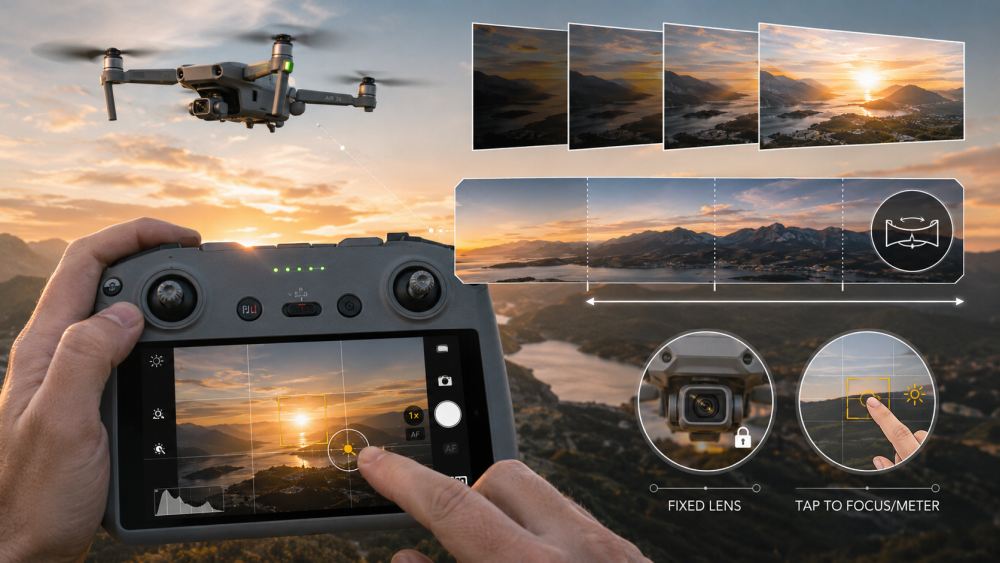
If you’re already a photographer, you’re ahead of the curve here — the menus and exposure logic are familiar. The main differences on most consumer drones:
- Fixed focal length, usually around 24mm equivalent, and fixed aperture, typically f/1.7–f/1.8
- Small sensors compared to a full-frame DSLR, so noise shows up faster — avoid high ISOs and don’t expect to rescue dark shadows the way you might on a bigger sensor
- Tap the screen to set both focus and exposure metering before shooting — tap something dark and the image brightens, tap something bright like the sky and it darkens
For high-contrast scenes, especially sunsets, use the built-in bracketing to take a set of shots one stop apart, then blend them for HDR or hand-mask them yourself. You can’t do HDR on drone panoramas, but most models let you tap the top-left and bottom-right corners of a scene to shoot a proper panorama instead — a genuinely useful trick worth using.
If you’re already considering this as a service rather than just a hobby, it’s worth a look at the different ways photographers are making money with drone work once you’re past the practice stage. And if your first drone purchase was years ago, it’s also worth comparing what’s changed since — my own first few weeks with a drone looked very different to what a Mini 5 Pro can do today.
Cheers, Ade
FAQ
Do I need a Flyer ID and Operator ID to fly a drone in the UK?
Since 1 January 2026, you need a Flyer ID for any drone weighing 100g or more, down from the old 250g threshold. If the drone has a camera, you also need an Operator ID, which costs £12.34 a year and must be displayed on the aircraft.
Can the DJI Air 3S fly over people now?
Yes, within limits. From 1 January 2026 to 31 December 2027, C1-class drones including the Air 3S can fly in the Over People (A1) sub-category up to 900g, a privilege previously limited to sub-250g drones.
Does the A2 CofC still exist in 2026?
Yes. It’s been renamed the Near People (A2) qualification but works the same way: a theory-only course costing roughly £100–£250, valid for five years with no annual renewal fee.
Does DJI Care Refresh cover damage to other people’s property?
No. Care Refresh only covers your own drone if you crash or damage it. It is not third-party liability insurance, which covers injury or damage you cause to someone else and is a legal requirement for commercial drone work.
Which DJI drone should a photographer buy first?
For most photographers starting out, the DJI Mini 5 Pro is the best first drone: sub-250g, a 1-inch sensor, and the fewest legal restrictions. Step up to the Air 3S if you want a second, longer lens and don’t mind the extra weight and cost.
Related Reading


Related Posts

5 Post Shoot Tips to Safeguard Your Precious Shots
Summer Nights Workshop – 2016 Review
How to organise your photos like a pro
Business Profile Shoot with Gayle Partridge
Lightroom Recovery – Transforming a Dull Day Landscape
Leeds Architecture 2020
Best Camera Kit for Beginner Photographers: A Complete Guide
Choosing the Best Canon Mirrorless Camera for Beginners